





Nanobubble Generators & PSA Oxygen Generators Acniti Manufacturer
Don't settle for one-size-fits-all. Acniti engineers 3 distinct nanobubble technologies to match your specific application—from high-volume agriculture to high-concentration research.
Engineered Solutions for Critical Industries
In a research lab, small variations ruin good data. One team spent months repeating the same experiment, only to discover their aeration system was drifting in performance. With GaLF lab-scale nanobubble generators, they locked in a repeatable bubble size and concentration, run after run. Instead of wondering whether the water phase had changed, they could finally trust their baseline and focus on the science, not the hardware.
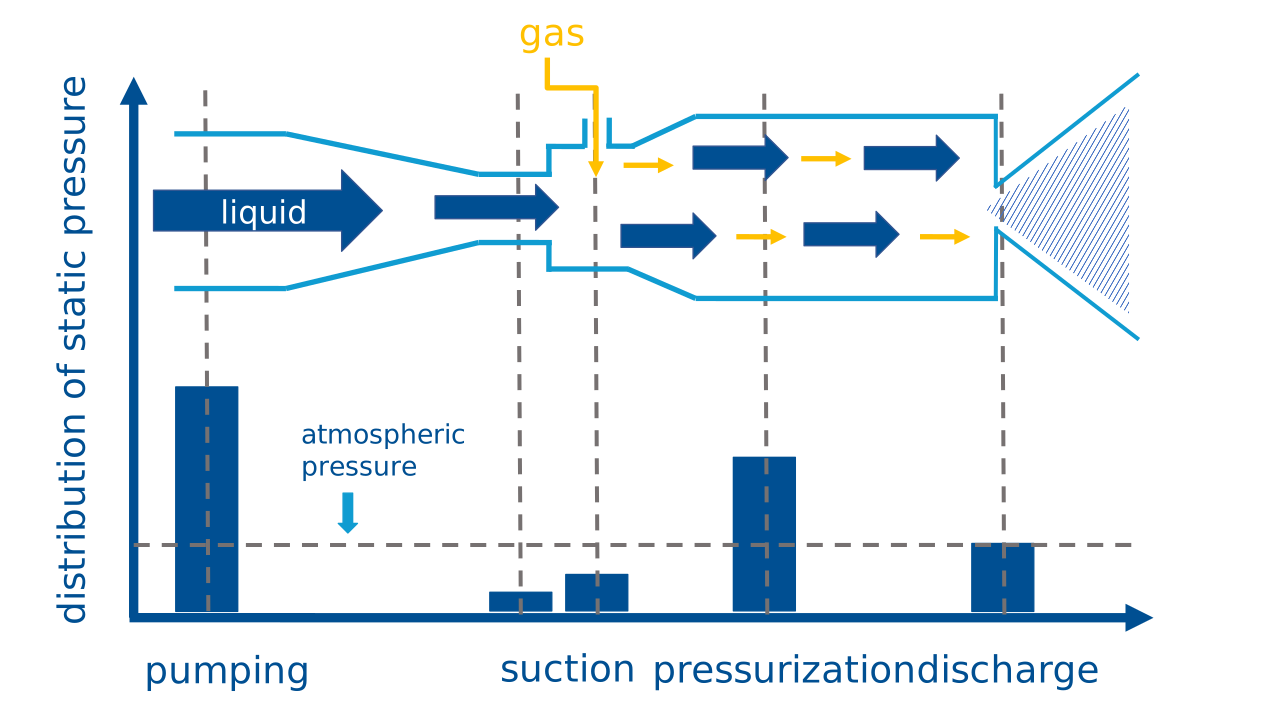
In a greenhouse outside a major city, an agronomist faced yellowing leaves and uneven growth, even though nutrient recipes were correct. The problem was oxygen-starved roots in dense substrate. By adding a Turbiti nanobubble generator to the irrigation loop, dissolved oxygen increased and stayed stable across the entire system. Within weeks, root mass improved, crops became more uniform, and energy use remained low because the mixer technology is inherently efficient.
At a wastewater plant struggling with biofilm and odor complaints, operators were trapped between rising chemical costs and tightening discharge limits. Switching to ozone nanobubbles allowed them to attack biofilm and pathogens directly in the water column, using far less chemical dosing. Hammer-mill based nanobubble generation with microStar made the process energy-efficient, and the team saw cleaner tanks, fewer complaints, and more predictable compliance with their permits.

Choose the right Technology for you.


Integrated Oxygen for Smarter Nanobubbles
When the same team engineers both the nanobubble generator and the oxygen source, the entire system runs more stable, cleaner, and easier to service.
A typical nanobubble project starts with two vendors: one for the generator, another for the oxygen systems. When performance drops, each supplier blames the other. Acniti removed that uncertainty by designing industrial oxygen generators specifically for nanobubble applications, starting in 2020. The Oxiti line is engineered for harsh environments, with stable 90–93% oxygen output that matches the pressure and flow requirements of Turbiti, GaLF, and other Acniti systems.
This integration matters in the field. In an aquaculture facility, oxygen demand spikes with biomass and temperature. A generic medical concentrator can drift or trigger alarms when pushed beyond its design envelope. An Oxiti unit, sized and tuned for continuous industrial use, feeds a Turbiti generator with stable oxygen, keeping dissolved oxygen levels where they should be without constant operator intervention. The result is fewer stress events, more predictable growth, and lower risk of sudden losses.
In wastewater or mining, uptime is critical and access is limited. Here, every component must tolerate dust, vibration, and variable power quality. Oxiti generators are built as part of a complete gas–water system, not as an afterthought. Service intervals, filtration, and controls are aligned with the nanobubble hardware, so maintenance teams deal with one specification set and one engineering partner. For B2B buyers, this means fewer unknowns, simpler commissioning, and a single point of accountability for gas quality and bubble performance.
Trusted by Innovators Worldwide
Acniti was born in Osaka, Japan—the birthplace of nanobubble technology. Since 2017, we have operated from our Minoh headquarters and workshop, where Japanese precision meets practical engineering. Our team designs, assembles, and tests every generator and oxygen generator before it ships to customers across six continents. From university research labs in Europe to commercial farms in Israel, aquaculture facilities in South America, and mining operations in harsh industrial zones, Acniti equipment delivers reliable performance where it matters most.
We work with organizations that cannot afford guesswork. Leading agricultural universities rely on our GaLF generators to produce peer-reviewed data on root oxygenation. Industrial clients in wastewater and food processing choose Turbiti systems because downtime is expensive and chemical dependency is a liability. Research institutions testing advanced oxidation processes trust our ozone-capable platforms to deliver consistent results across thousands of test cycles.
One European greenhouse operator faced declining tomato yields despite optimized nutrients and lighting. After integrating a Turbiti nanobubble system into their irrigation network, dissolved oxygen levels stabilized, root health improved visibly within two weeks, and overall yield increased by 18% over the growing season. The operator noted that energy costs barely changed because our static mixer technology requires no high-pressure pumps or complex maintenance schedules.
Whether you are validating a new cultivation method, scaling a water treatment process, or exploring nanobubble applications in mining and concrete curing, Acniti provides the engineering support and proven hardware to make your project succeed. Engineered in Japan. Trusted worldwide.


Global Reach: Trusted by Customers in Over 60 Countries
From our engineering headquarters in Japan, Acniti has built a global reputation for excellence in nanobubble technology and oxygen generation systems. To date, we have successfully supplied and supported innovative projects in more than 60 countries across six continents. Whether it is enhancing crop yields in European greenhouses, optimizing aquaculture in South America, or supporting advanced research in North American laboratories, our technology is the preferred choice for industries seeking sustainable water treatment solutions. Our expansive international footprint is a testament to the reliability, efficiency, and Japanese precision engineered into every Acniti system.